
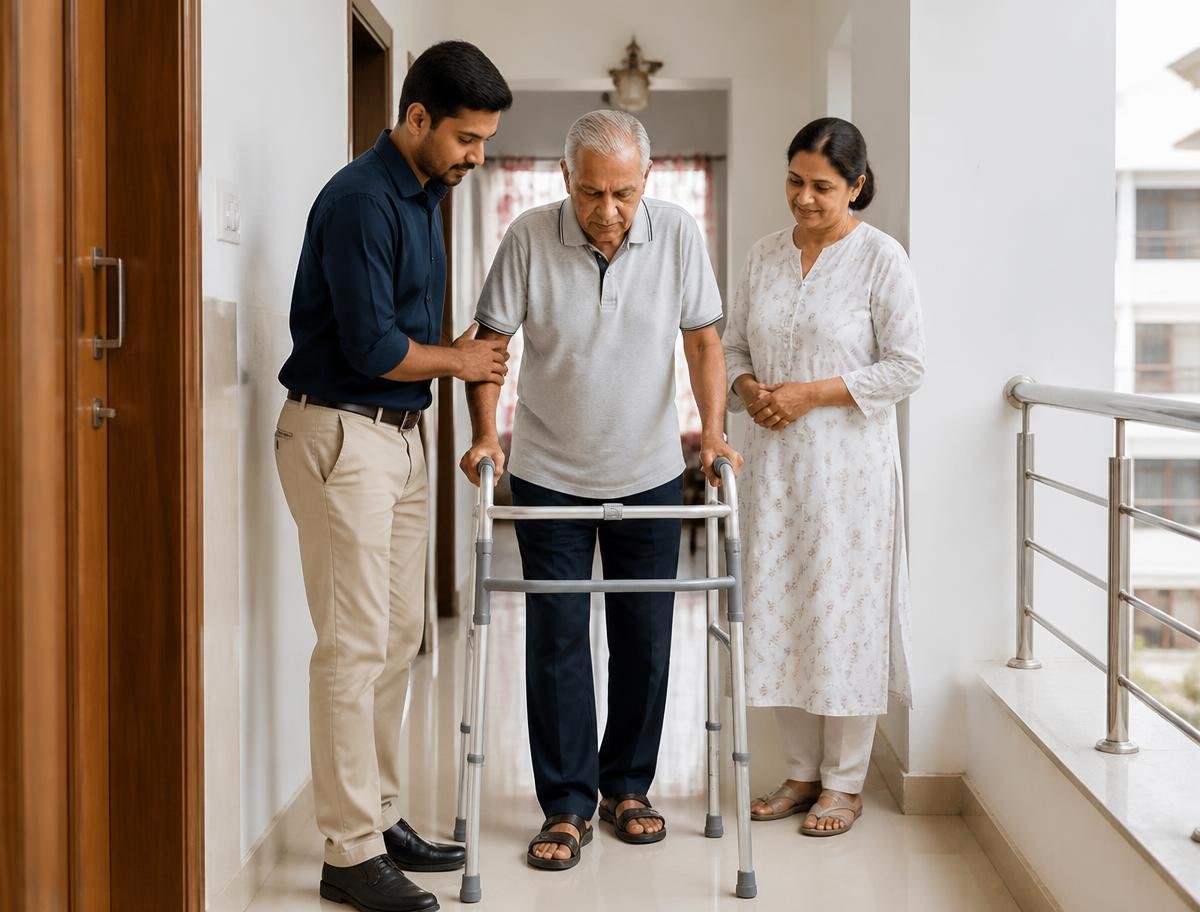
Home physiotherapy service
Back Pain Home Physiotherapy in Indirapuram
Back pain is the reason most people first call a physiotherapist, and it's also the one people put off the longest. It settles for a week, comes back after a long drive or a heavy lift, and slowly the list of things you avoid gets longer.
Treating it at home has a practical advantage. Most back pain is provoked by ordinary positions: your office chair, the way you sit on the sofa in the evening, a mattress that's too soft, the bend you do to pick up a child. Those are all in your flat, and a therapist can look at them directly instead of relying on your description.
Who can benefit
Back pain physiotherapy tends to help people who are:
- Sitting for long hours at a desk, in meetings or driving
- Lifting, bending or carrying regularly at work or at home
- Recovering from a disc-related problem and cautious about moving
- Getting older and noticing morning stiffness that takes longer to clear
- In pain that shoots down one leg into the calf or foot
- Back at the gym after a break and flaring the same spot each time
Common problems and symptoms
Common patterns we hear:
- A dull ache low in the back that worsens through the day
- Sharp pain on bending forward, or on straightening up afterwards
- Stiffness in the first thirty minutes after waking
- Pain radiating into the buttock, thigh or below the knee
- Pins and needles or a heavy, dead feeling in one leg
- Difficulty sitting through a car journey or a full film
- A back that feels fine until you turn suddenly, then locks up
How physiotherapy can help
The first job is separating what's irritable from what's weak. Those need opposite handling. An angry, acutely painful back needs pain settled and gentle movement restored before any strengthening will be tolerated. A back that's been sore for eight months usually needs the opposite: more load, not less, applied gradually.
We test how you bend, rotate, sit and stand, check hip and hamstring flexibility, and look at whether your trunk and hip muscles are actually doing their share. Treatment then combines hands-on work where a segment is stiff, specific exercise, and honest advice about which activities to keep doing. Rest for more than a day or two rarely helps back pain and often makes the next flare worse.
- Manual therapy and mobilisation for stiff spinal segments
- Graded core, hip and back strengthening, progressed week by week
- Nerve mobility work when leg symptoms are involved
- Ergonomic changes to your own chair, desk, bed and car seat
- Lifting and bending technique practised with real objects at home
- A pacing plan so activity increases without repeated flare-ups
Physiotherapy outcomes differ from person to person and depend on the condition, its cause and other medical factors. This site is general information, not a diagnosis or a treatment plan for any individual. Where a medical review, imaging or a specialist opinion is needed, we will say so and ask you to see your doctor.
The visit
What to expect during a home session
- Initial discussion. When it started, where exactly it hurts, whether anything travels into the leg, and what you've tried so far.
- Screening questions. A short set of questions about bladder, bowel, night pain and unexplained weight loss, to rule out anything that needs a doctor first.
- Movement assessment. Bending forward, backward and sideways, plus nerve tension tests if the pain goes below the knee.
- Strength and control testing. Hip strength, trunk control and how you transfer weight when you stand up or step.
- Treatment plan. Which findings we think explain your symptoms, what to change first, and what we expect over the next two to three weeks.
- Therapy and exercise. Mobilisation or soft tissue work as needed, then two or three exercises taught properly rather than a long list done badly.
- Home guidance and review. Sitting setup, sleeping position and a short daily routine. Symptoms and movement are re-measured at the next visit.
Home visits
Treatment at home, across Indirapuram and nearby
Why home physiotherapy?
Travelling with an acute back is its own problem. Twenty minutes in an auto over Indirapuram's speed breakers can undo the benefit of the session you just paid for.
There's also the setup question. Your chair, your mattress and your desk height are fixed variables in your recovery, and they're much easier to fix when someone is standing in front of them.
- No car or auto journey while the back is irritable
- Your actual chair, bed and desk get assessed, not a generic version
- Lifting technique practised with the things you really lift
- Easy to schedule two sessions in a week during a flare
Areas we serve
Back pain is the most common reason people in Ahinsa Khand and Niti Khand call us.
Sessions run across Indirapuram, including Ahinsa Khand 1 and 2, Niti Khand, Shakti Khand, Vaibhav Khand, Gyan Khand and Shipra Suncity. We also travel to Vaishali, Vasundhara, Crossing Republik, Noida and Greater Noida West, depending on the day's schedule.
Our address is VPL-19, Lower Ground, Shipra Krishna Vista Plaza, Ahinsa Khand 1, Indirapuram, Ghaziabad 201001, Near Shanti Gopal Hospital and Jaipuria Mall, Indirapuram.
FAQ
Questions about back pain home physiotherapy
Can back pain physiotherapy really be done at home?
Yes. Assessment, manual therapy and exercise all work in a home setting. Your own bed, a chair and a bit of floor space cover most of what's needed for back rehabilitation.
How many sessions does back pain usually take?
For a recent, straightforward episode, often four to six visits alongside a home programme. Long-standing pain or disc-related symptoms take longer. We'll give you a realistic range after the assessment.
Should I get an MRI first?
Usually not. Most back pain doesn't need imaging, and scans often show changes that are normal for your age and unrelated to your pain. If your symptoms suggest imaging is warranted, we'll tell you to see your doctor about it.
Is bed rest good for back pain?
A day or two of reduced activity during a severe flare is reasonable. Beyond that, extended rest tends to make stiffness and weakness worse. Gentle, regular movement generally recovers faster.
What if the pain goes down my leg?
Leg symptoms usually mean a nerve is involved, and the assessment includes specific tests for that. It changes which exercises are safe early on. Sudden weakness in the leg, numbness around the groin or loss of bladder control needs urgent medical attention, not physiotherapy.
Will I need to stop exercising completely?
Rarely. More often it's a matter of changing which exercises, and how heavy, for a few weeks. Stopping everything tends to make the return harder.
Guides
Related reading for this condition
Physiotherapy for Sciatica
Sciatica management focuses on reducing nerve irritation, restoring movement and rebuilding tolerance for sitting and walking.
Read the guideBack Pain Exercises and Physiotherapy
Back pain management usually combines symptom relief, movement retraining and progressive strengthening.
Read the guideFall Prevention at Home: Physiotherapy Tips for Older Adults
Falls are not an inevitable part of ageing. A safer home, appropriate strength and balance work, and review of individual risk factors can help older...
Read the guideRelated
Other services that may be relevant
Home Physiotherapy
A physiotherapist comes to your home in Indirapuram for assessment, treatment and a plan you can actually follow.
Office Pain Home Physiotherapy
Treatment for desk-related neck, back, wrist and hip pain, with your actual workstation assessed.
Post-Surgery Home Physiotherapy
Rehabilitation after joint replacement, fracture fixation, ligament repair and other surgery, delivered from the day you get home.
Book Back Pain Home Physiotherapy in Indirapuram
Call or WhatsApp us to discuss your requirement and availability.
Monday to Saturday: 07:00 - 21:00 · Sunday: 07:00 - 12:00