
Home physiotherapy service
Neurological Home Physiotherapy in Indirapuram
Neurological conditions rarely announce themselves with a single event. More often a family notices that walking has slowed, that turning in the corridor now takes several small steps, or that buttons have become difficult. By the time someone calls, they've usually been adapting quietly for months.
Physiotherapy here isn't about curing the underlying condition. It's about keeping movement, strength and independence for as long as possible, and about making the home safer while that happens. For progressive conditions, holding ground is a genuine result.
Who can benefit
We see patients living with:
- Parkinson's disease and related movement disorders
- Spinal cord injury, complete or partial
- Peripheral neuropathy, including diabetic neuropathy
- Multiple sclerosis
- Bell's palsy and other nerve palsies affecting movement
- Balance and coordination problems of neurological origin
Common problems and symptoms
What tends to bring people to us:
- Slow, shuffling walking or difficulty starting the first step
- Freezing in doorways or when turning
- Numbness in the feet that makes walking feel uncertain
- Tremor or stiffness interfering with daily tasks
- Repeated near-falls, or an actual fall
- Weakness that has developed gradually over months
- Fatigue that limits how much can be done in a day
How physiotherapy can help
Different conditions need different approaches, and lumping them together is a mistake. Parkinson's responds well to large-amplitude movement, external cues and rhythm, because the problem is partly one of scaling movement rather than producing it. Neuropathy needs balance work and foot care awareness, since the feet aren't sending back reliable information. Spinal cord injury needs strength in what's preserved, plus transfer technique and pressure care.
What they share is that consistency beats intensity. A moderate programme done most days will do more than a hard session once a week, and pacing around fatigue is part of the plan rather than an afterthought.
- Condition-specific programmes rather than one general exercise sheet
- Cueing strategies for freezing and gait initiation in Parkinson's
- Balance and proprioception work where sensation is reduced
- Strength and endurance within a sensible fatigue budget
- Transfer, wheelchair and mobility aid training where relevant
- Home hazard review to reduce fall risk
Physiotherapy outcomes differ from person to person and depend on the condition, its cause and other medical factors. This site is general information, not a diagnosis or a treatment plan for any individual. Where a medical review, imaging or a specialist opinion is needed, we will say so and ask you to see your doctor.
The visit
What to expect during a home session
- Initial discussion. Diagnosis, how long it's been present, medication timing, what has changed recently and what the family is most worried about.
- Observation of movement. Walking, turning, standing up and reaching, watched at normal speed rather than performed on command.
- Neurological screening. Tone, sensation, coordination and balance tested as relevant to the diagnosis.
- Balance and fall risk assessment. Standing balance, reaching limits and how the patient recovers from a small loss of balance.
- Treatment plan. Realistic goals, whether the aim is improvement or maintaining current function, and how fatigue will be managed.
- Therapy and practice. Task-based practice with cueing, balance training with appropriate support, and strengthening at a level that doesn't exhaust the patient.
- Home guidance and review. A daily routine, hazard fixes for the areas where falls are likely, and periodic reassessment of the same measures.
Home visits
Treatment at home, across Indirapuram and nearby
Why home physiotherapy?
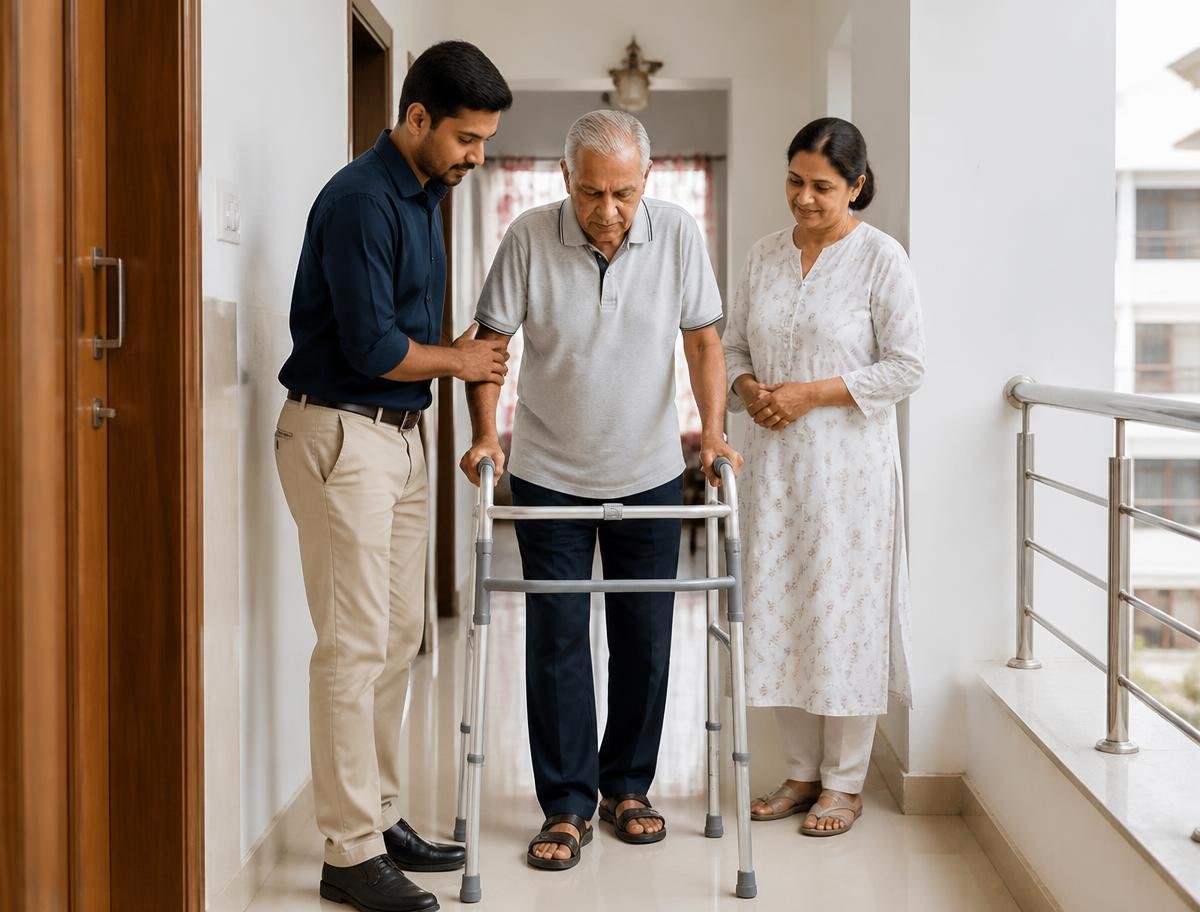
Freezing episodes in Parkinson's happen at specific places: a narrow doorway, the turn into the kitchen, the threshold to the balcony. Those are the exact spots to practise, and they only exist in your flat.
Fatigue is the other reason. For someone with a neurological condition, the journey to a clinic can consume the energy that should have gone into the session.
- Practice at the doorways and turns that actually cause trouble
- No energy spent on travel before treatment starts
- Medication timing can be worked around, which matters in Parkinson's
- Hazards like loose mats and poor lighting get addressed directly
Areas we serve
Neurological cases often come through family referrals across Indirapuram, Vaishali and Noida.
Sessions run across Indirapuram, including Ahinsa Khand 1 and 2, Niti Khand, Shakti Khand, Vaibhav Khand, Gyan Khand and Shipra Suncity. We also travel to Vaishali, Vasundhara, Crossing Republik, Noida and Greater Noida West, depending on the day's schedule.
Our address is VPL-19, Lower Ground, Shipra Krishna Vista Plaza, Ahinsa Khand 1, Indirapuram, Ghaziabad 201001, Near Shanti Gopal Hospital and Jaipuria Mall, Indirapuram.
FAQ
Questions about neurological home physiotherapy
Can physiotherapy slow down a progressive condition?
It doesn't change the underlying disease. What it can do is maintain strength, balance and function, and reduce the secondary problems that come from moving less. For many people that's the difference between independence and dependence.
What helps freezing of gait in Parkinson's?
External cues often work better than trying harder. A rhythmic count, a line to step over, or a deliberate weight shift before the first step can all unlock a freeze. We work out which cue suits the individual.
Is exercise safe with neuropathy in the feet?
Generally yes, with attention to footwear, surfaces and daily foot checks, because reduced sensation means injuries can go unnoticed. Balance training is particularly worthwhile.
How do you handle fatigue during sessions?
We plan around it rather than pushing through. Shorter bouts with rest, scheduling at the patient's better time of day, and setting a daily amount that doesn't leave them wiped out the next morning.
Do you coordinate with the treating neurologist?
We work within whatever your neurologist has advised, and we'll tell you when something we've found should be reported back to them.
How long does a course of treatment run?
For progressive conditions it's often an ongoing arrangement with periodic review rather than a fixed course. Some patients see us weekly, others monthly for reassessment and programme updates.
Guides
Related reading for this condition
Home Physiotherapy for Stroke Patients
Stroke rehabilitation at home focuses on practical function and consistency, with family training as a key part.
Read the guideFall Prevention at Home: Physiotherapy Tips for Older Adults
Falls are not an inevitable part of ageing. A safer home, appropriate strength and balance work, and review of individual risk factors can help older...
Read the guideHow to Exercise Safely at Home During Physiotherapy
A home exercise plan works best when it is specific, manageable and performed consistently. Use these checks to exercise safely between physiotherapy...
Read the guideRelated
Other services that may be relevant
Stroke Rehabilitation Home Physiotherapy
Home-based rehabilitation after stroke, working on weakness, balance, transfers and getting back to daily tasks.
Mobility and Balance Home Physiotherapy
Focused work on walking, steadiness and confidence for people who feel unsafe on their feet.
Geriatric Home Physiotherapy
Strength, balance and mobility work for older adults, with fall prevention and a focus on staying independent at home.
Book Neurological Home Physiotherapy in Indirapuram
Call or WhatsApp us to discuss your requirement and availability.
Monday to Saturday: 07:00 - 21:00 · Sunday: 07:00 - 12:00