
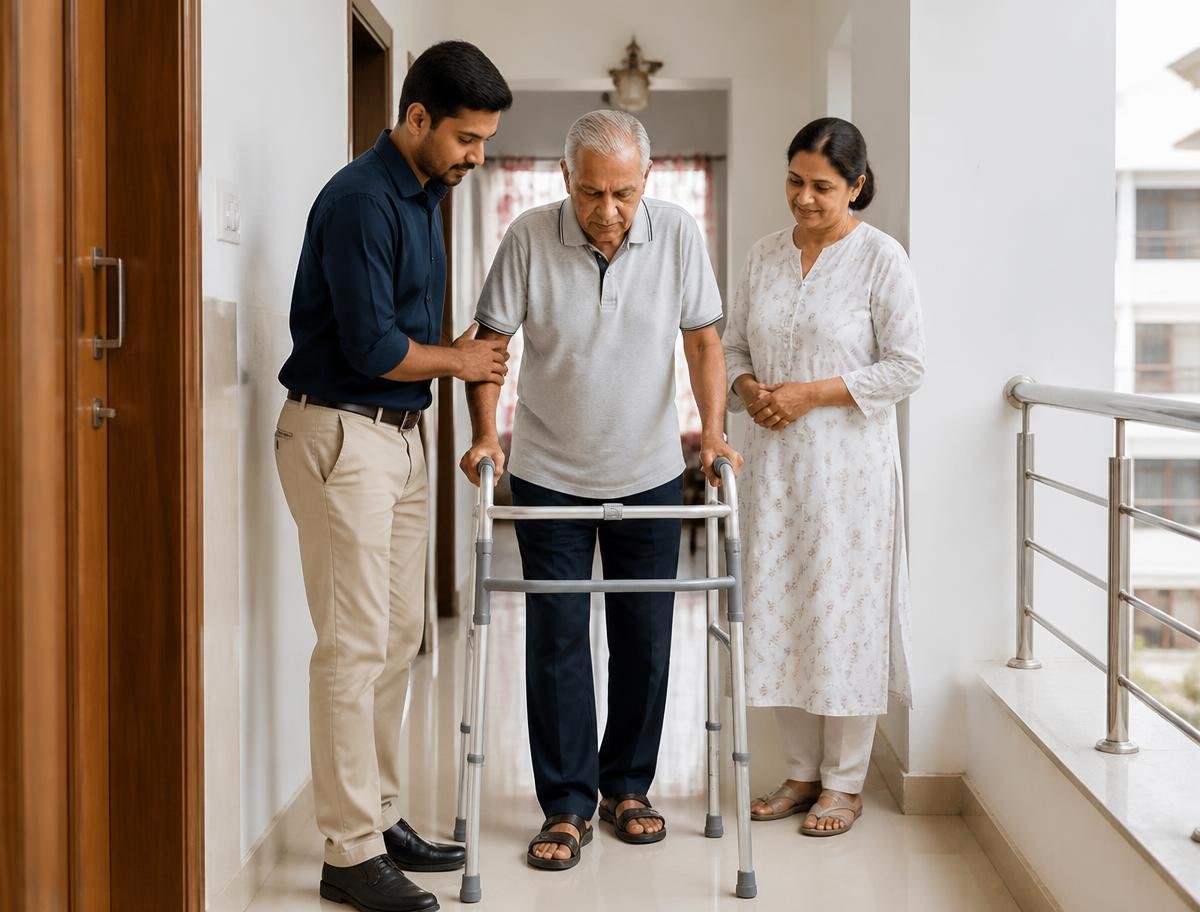
Home physiotherapy service
Knee Pain Home Physiotherapy in Indirapuram
Knees announce themselves on stairs. Most people who call us have been managing for months and only pick up the phone when the second-floor climb becomes a two-hands-on-the-railing job, or when getting up from a floor mat starts needing a plan.
Two people with knee pain can need completely different treatment. One has an osteoarthritic knee that needs strength and confidence rebuilt. The other tore something playing badminton at the society court and needs swelling controlled and range restored first. Getting that distinction right at the assessment is most of the work.
Who can benefit
Knee physiotherapy is usually appropriate if you have:
- Osteoarthritis and increasing difficulty with stairs or squatting
- A recent sprain or twist that's left the knee swollen
- Pain around or under the kneecap when sitting for long periods
- A knee that gives way, locks or catches
- Stiffness after a period of immobilisation
- An older parent who has stopped walking in the park because of knee pain
Common problems and symptoms
What we hear most often:
- Pain on the inner side of the knee when climbing or descending stairs
- Swelling that comes up after activity and settles overnight
- Grinding or crunching when bending the knee
- Difficulty sitting cross-legged or getting up from the floor
- Stiffness after sitting through a long meeting or a car journey
- A feeling that the knee might buckle on uneven ground
- Pain at night that makes finding a sleeping position awkward
How physiotherapy can help
Quadriceps strength is the single biggest lever in most knee problems, and it's usually the thing that has quietly disappeared. Even a few weeks of limping measurably shrinks the muscle above the knee, which then loads the joint worse, which hurts more. Breaking that loop is the priority.
Alongside that we work on range of movement, hip and calf strength, and how you actually move. A knee that hurts on stairs often has more to do with weak glutes and a poor step strategy than with the knee itself. For arthritic knees, load has to increase gradually but it does have to increase. Protecting the joint indefinitely makes it weaker, not safer.
- Quadriceps, hamstring, glute and calf strengthening, progressed by measurable steps
- Range of movement work for a stiff or swollen knee
- Swelling management and activity pacing after a flare
- Stair, sit-to-stand and floor transfer technique practised on your own stairs
- Balance work where the knee gives way on uneven surfaces
- Advice on footwear, walking distance and whether a support is worth using
Physiotherapy outcomes differ from person to person and depend on the condition, its cause and other medical factors. This site is general information, not a diagnosis or a treatment plan for any individual. Where a medical review, imaging or a specialist opinion is needed, we will say so and ask you to see your doctor.
The visit
What to expect during a home session
- Initial discussion. Which movements hurt, whether there was an injury, how far you can walk now compared with six months ago.
- Examination of the knee. Swelling, warmth, tenderness and joint line pain, plus ligament and meniscus tests where an injury is suspected.
- Range measurement. Bending and straightening measured properly, so progress can be compared visit to visit rather than guessed at.
- Strength and functional testing. Quadriceps and hip strength, sit-to-stand repetitions, and how you handle your own staircase.
- Treatment plan. Whether the priority is settling swelling, restoring range or building strength, and roughly how long that phase runs.
- Therapy and exercise. Manual work for a stiff joint, then loaded exercise at a level that challenges the muscle without provoking the joint.
- Home guidance and review. Two or three exercises with clear repetitions, walking guidance for the week, and a recheck of range and strength next visit.
Home visits
Treatment at home, across Indirapuram and nearby
Why home physiotherapy?
Stairs are the reason. Your building's staircase has a specific step height, a specific railing on one side and a landing that turns. Practising on it is worth far more than practising on a clinic's demo step.
For knee arthritis in particular, most of the progress happens between visits. Setting the home programme up on the same floor you'll do it on makes it far more likely to actually get done.
- Your own stairs, floor mat and bathroom threshold get used in training
- No painful stair descent to reach an auto or lift
- Family can be shown how to assist a floor transfer safely
- Realistic walking targets set for your actual society layout
Areas we serve
Knee rehabilitation is one of our most requested services in Shipra Suncity and Aditya Mega City, where a large number of senior residents live.
Sessions run across Indirapuram, including Ahinsa Khand 1 and 2, Niti Khand, Shakti Khand, Vaibhav Khand, Gyan Khand and Shipra Suncity. We also travel to Vaishali, Vasundhara, Crossing Republik, Noida and Greater Noida West, depending on the day's schedule.
Our address is VPL-19, Lower Ground, Shipra Krishna Vista Plaza, Ahinsa Khand 1, Indirapuram, Ghaziabad 201001, Near Shanti Gopal Hospital and Jaipuria Mall, Indirapuram.
FAQ
Questions about knee pain home physiotherapy
Will physiotherapy help arthritis, or do I need a knee replacement?
Many people with osteoarthritis manage well with strengthening and activity changes for years. Surgery is a decision between you and an orthopaedic surgeon, based on your pain, function and X-rays. Physiotherapy is worth trying first in most cases and is useful before surgery too.
Is walking good or bad for knee pain?
Generally good, in the right dose. Long walks on hard ground while the knee is flared can aggravate it. We usually set a distance you can manage without a next-day increase in pain and build from there.
Should I use a knee cap or brace?
Sometimes, for short periods, when it genuinely improves confidence during activity. Wearing one all day for months isn't ideal because the muscles do less. We'll advise based on what we find.
Can I still climb stairs?
In most cases yes, with technique changes. Leading with the stronger leg going up and the weaker one going down, and using the railing, reduces the load considerably.
How long before I can sit cross-legged again?
That needs close to full knee bend, so it's usually one of the later milestones. Some arthritic and post-surgical knees don't get all the way there, and that's worth knowing early rather than late.
My knee swells after exercise. Should I stop?
Swelling that settles within a few hours usually means the dose was slightly high, not that exercise is wrong. Swelling that lasts into the next day means we reduce the load. Tell us either way and we'll adjust.
Guides
Related reading for this condition
Physiotherapy for Knee Pain at Home
Knee pain treatment at home combines pain management, strengthening and practical training on the patient's own stairs and seating.
Read the guidePhysiotherapy After Knee Replacement Surgery
Knee replacement rehabilitation focuses on restoring bending and straightening, rebuilding thigh strength and returning to safe walking.
Read the guideFall Prevention at Home: Physiotherapy Tips for Older Adults
Falls are not an inevitable part of ageing. A safer home, appropriate strength and balance work, and review of individual risk factors can help older...
Read the guideRelated
Other services that may be relevant
Post-Surgery Home Physiotherapy
Rehabilitation after joint replacement, fracture fixation, ligament repair and other surgery, delivered from the day you get home.
Geriatric Home Physiotherapy
Strength, balance and mobility work for older adults, with fall prevention and a focus on staying independent at home.
Mobility and Balance Home Physiotherapy
Focused work on walking, steadiness and confidence for people who feel unsafe on their feet.
Book Knee Pain Home Physiotherapy in Indirapuram
Call or WhatsApp us to discuss your requirement and availability.
Monday to Saturday: 07:00 - 21:00 · Sunday: 07:00 - 12:00