
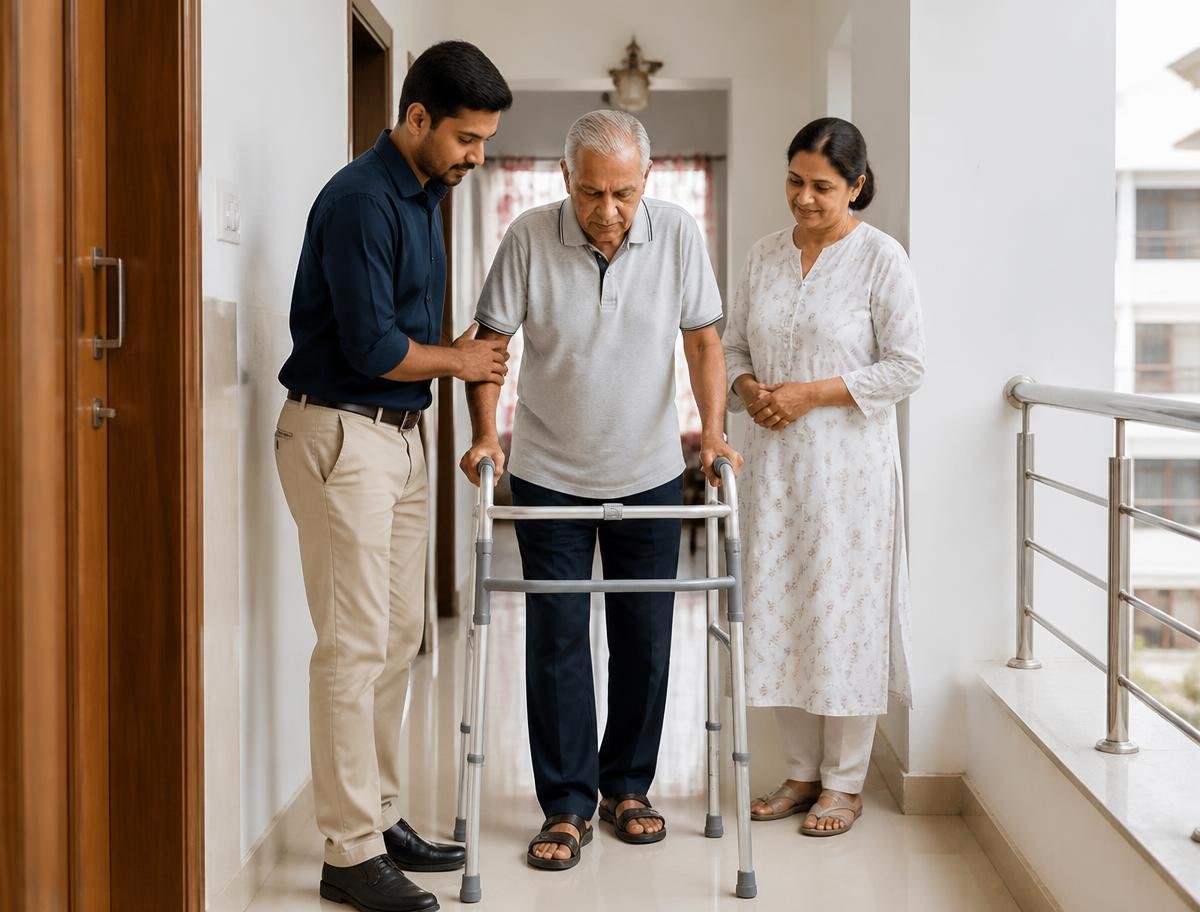
Home physiotherapy service
Geriatric Home Physiotherapy in Indirapuram
A lot of the decline people accept as ageing is actually disuse, and disuse responds to training. Someone who stopped walking in the park after a bout of illness loses strength quickly, then feels unsteady, then walks less, and within a year the family is discussing a wheelchair.
That sequence can often be interrupted. Older adults build strength at any age, just more slowly and with more attention to recovery. The work is unglamorous: standing up from a chair, walking a bit further, keeping the ankles and hips moving. It also happens to be the work that keeps someone living independently in their own flat.
Who can benefit
Geriatric physiotherapy is worth considering when an older person:
- Has had a fall, or has come close to falling
- Struggles to get up from a chair without pushing off with both arms
- Has stopped going for walks or down to the park
- Feels unsteady on the stairs or in the bathroom
- Has become much less active after an illness or hospital stay
- Has joint pain that's limiting how much they move
Common problems and symptoms
What families usually notice first:
- Slower, shorter steps and a wider stance while walking
- Holding on to furniture while moving around the house
- Needing several attempts to stand up from a low sofa
- Reluctance to bathe alone or use the bathroom without help
- Stiffness in the knees and hips, worst in the morning
- Loss of confidence outdoors, especially on uneven paths
- Increasing time spent sitting or lying down
How physiotherapy can help
Assessment starts with function, not with a list of diseases. How many times can they stand up from a chair in thirty seconds? How long can they stand on one leg? How far can they walk before stopping? Those numbers give a baseline that's easy to re-measure and easy for the family to understand.
Training then targets the specific weaknesses found, usually leg strength, ankle mobility and balance reactions. We also look at the flat itself, because a loose rug, a dim corridor at night or a bathroom with no grab support does more damage than any exercise programme can undo. Pain gets managed alongside, since nobody trains well while their knee is flaring.
- Leg and hip strengthening scaled to the person's current ability
- Balance training progressed from supported to unsupported
- Sit-to-stand and floor transfer practice
- Walking distance built up gradually with a weekly target
- Home hazard review: lighting, rugs, bathroom, thresholds
- Advice on walking aids, and how to use them properly if needed
Physiotherapy outcomes differ from person to person and depend on the condition, its cause and other medical factors. This site is general information, not a diagnosis or a treatment plan for any individual. Where a medical review, imaging or a specialist opinion is needed, we will say so and ask you to see your doctor.
The visit
What to expect during a home session
- Initial discussion. Medical history, medication, previous falls, and a clear picture of what they could do six months and two years ago.
- Functional measures. Sit-to-stand count, standing balance timing and walking observed over a set distance in the corridor or flat.
- Joint and strength assessment. Knee, hip and ankle range, leg strength, and any pain that limits movement.
- Home safety walkthrough. Bathroom, bedroom, kitchen and the route to the door, checked for the hazards that cause most falls.
- Treatment plan. Goals set in terms the family recognises, like getting to the park bench and back, with a sensible timeframe.
- Therapy and exercise. Strength and balance work using a sturdy chair and a wall, at a level that's challenging but safe with the therapist there.
- Home guidance and review. A short daily routine the family can supervise, plus re-measurement of the same functional tests every few weeks.
Home visits
Treatment at home, across Indirapuram and nearby
Why home physiotherapy?
For a frail older person, the trip to a clinic is often the single hardest physical activity of the week, and it leaves nothing in the tank for the actual session.
There's also a dignity issue that gets overlooked. Practising getting on and off your own toilet, or in and out of your own bath, is more useful and less exposing than doing an approximation of it in front of strangers.
- No stressful journey before or after treatment
- Real bathroom, bed and stairs used for practice
- Family and domestic help can be trained at the same time
- Hazards spotted and fixed during the visit
Areas we serve
A large share of our elderly patients live in Shipra Suncity, Aditya Mega City and the older societies of Ahinsa Khand.
Sessions run across Indirapuram, including Ahinsa Khand 1 and 2, Niti Khand, Shakti Khand, Vaibhav Khand, Gyan Khand and Shipra Suncity. We also travel to Vaishali, Vasundhara, Crossing Republik, Noida and Greater Noida West, depending on the day's schedule.
Our address is VPL-19, Lower Ground, Shipra Krishna Vista Plaza, Ahinsa Khand 1, Indirapuram, Ghaziabad 201001, Near Shanti Gopal Hospital and Jaipuria Mall, Indirapuram.
FAQ
Questions about geriatric home physiotherapy
Is my parent too old for physiotherapy?
Age by itself isn't a barrier. Strength and balance improve in people in their eighties and nineties. What changes is the pace of progression and how much recovery time is built in.
They've already had a fall. Is it too late?
No, and a fall is usually the strongest reason to start. Around half of people who fall once fall again, and targeted strength and balance work is one of the few things that reliably reduces that risk.
Will exercise make their knee arthritis worse?
Appropriately dosed exercise generally reduces arthritic pain rather than increasing it. The load has to be built up gradually, and we adjust it based on how the joint responds over the following day.
How often are sessions needed?
Often twice a week initially, tapering as the family becomes confident supervising the home programme. Some patients continue with a monthly review to keep the programme progressing.
Should we get a walker?
Only if it's genuinely needed, and set to the right height. A walker used too early can accelerate weakness. We'll assess and advise, and we'll also tell you when it's time to move away from one.
Can you help with fall prevention at home?
Yes. Lighting, loose mats, bathroom surfaces, footwear and night-time routes to the toilet are all part of the assessment, alongside the strength and balance training.
Guides
Related reading for this condition
Fall Prevention at Home: Physiotherapy Tips for Older Adults
Falls are not an inevitable part of ageing. A safer home, appropriate strength and balance work, and review of individual risk factors can help older...
Read the guideHow to Exercise Safely at Home During Physiotherapy
A home exercise plan works best when it is specific, manageable and performed consistently. Use these checks to exercise safely between physiotherapy...
Read the guideImportance of Balance Training for Senior Citizens
Balance training aims to improve stability and reduce fall risk through progressive, supervised practice.
Read the guideRelated
Other services that may be relevant
Mobility and Balance Home Physiotherapy
Focused work on walking, steadiness and confidence for people who feel unsafe on their feet.
Knee Pain Home Physiotherapy
Rehabilitation for knee arthritis, ligament and cartilage problems, and the stair and squat difficulty that comes with them.
Home Physiotherapy
A physiotherapist comes to your home in Indirapuram for assessment, treatment and a plan you can actually follow.
Book Geriatric Home Physiotherapy in Indirapuram
Call or WhatsApp us to discuss your requirement and availability.
Monday to Saturday: 07:00 - 21:00 · Sunday: 07:00 - 12:00