
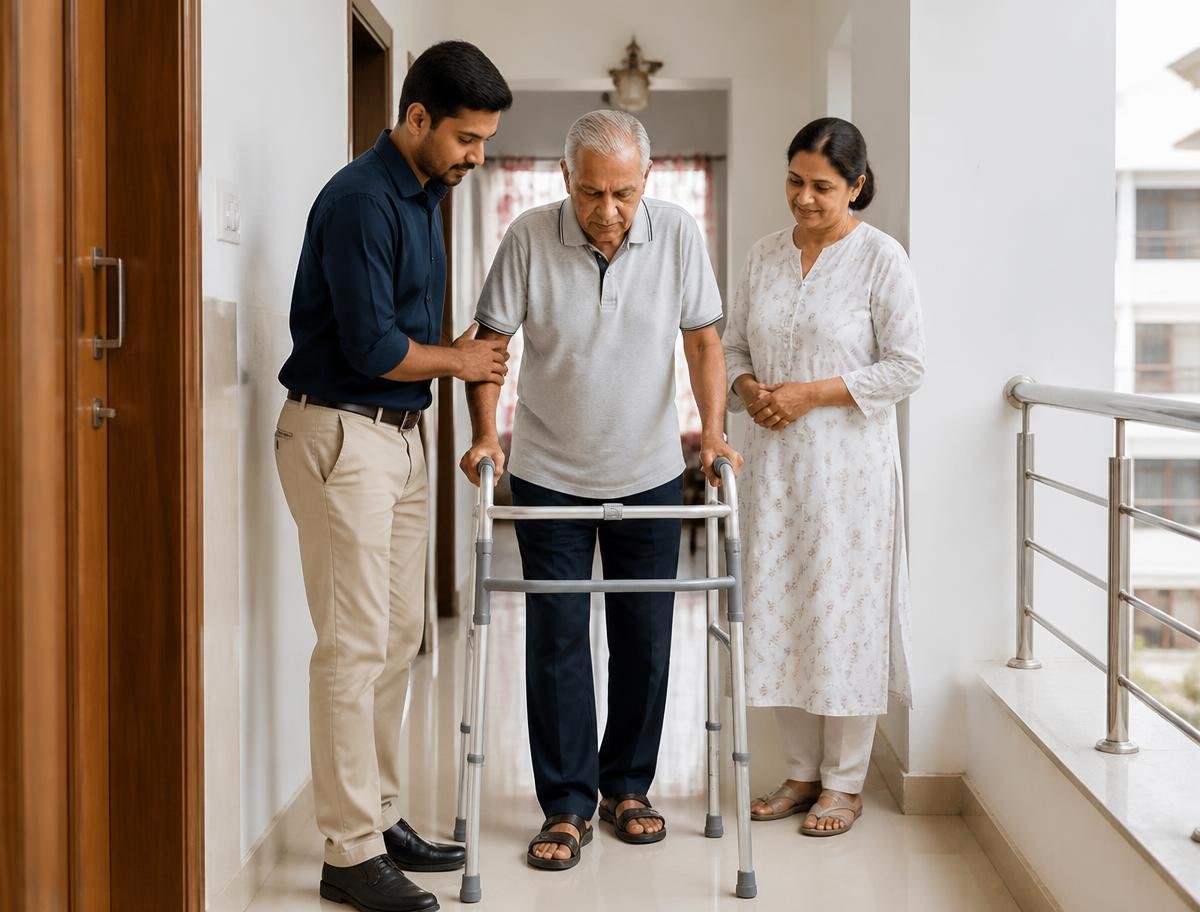
Home physiotherapy service
Stroke Rehabilitation Home Physiotherapy in Indirapuram
Coming home after a stroke is a difficult transition. In hospital there were nurses and a schedule. At home, the family suddenly owns the whole thing, and there's usually a gap between what the discharge advice said and what to actually do on a Tuesday morning.
Home physiotherapy fills that gap. Stroke rehabilitation is fundamentally about practising real tasks many times over, and the tasks that matter are all in the house: rolling over in bed, standing up, walking to the bathroom, holding a glass. Doing that work in the actual environment is more useful than doing it in a gym and hoping it transfers.
Who can benefit
We work with patients who are:
- Recently discharged after a stroke and needing rehabilitation to continue
- Weak down one side, in the arm, the leg or both
- Unable to walk safely without support
- Struggling with balance when standing or turning
- Dependent on family for transfers between bed, chair and toilet
- Months or years post-stroke but still with function worth improving
Common problems and symptoms
Common difficulties after stroke:
- Weakness or heaviness on one side of the body
- Foot that catches or drags when walking
- Stiffness or tightness developing in the affected arm
- Loss of balance when turning or reaching
- Difficulty getting from lying to sitting, or sitting to standing
- Reduced use of the affected hand for eating, dressing or grooming
- Fatigue that limits how much can be done in a session
How physiotherapy can help
The nervous system reorganises with practice, so the core of stroke rehabilitation is repetition of meaningful movement, at the right difficulty. Too easy and nothing changes. Too hard and the patient compensates with the strong side, which reinforces the pattern we're trying to break.
We work on the sequence that gets someone their independence back, usually in this order: bed mobility, sitting balance, sit to stand, standing balance, transfers, then walking and stairs. Arm and hand work runs alongside. We also spend time on positioning and gentle range, because a shoulder on a weak side can become painful and a tight ankle makes walking much harder later.
- Bed mobility, sitting balance and sit-to-stand training
- Gait retraining, with an aid or orthosis where it's genuinely needed
- Balance and weight transfer work onto the affected side
- Range of movement and positioning to reduce tightness and shoulder pain
- Task practice: dressing, feeding, reaching, holding
- Training for the family member who does the daily transfers
Physiotherapy outcomes differ from person to person and depend on the condition, its cause and other medical factors. This site is general information, not a diagnosis or a treatment plan for any individual. Where a medical review, imaging or a specialist opinion is needed, we will say so and ask you to see your doctor.
The visit
What to expect during a home session
- Initial discussion. Date and type of stroke, side affected, hospital rehabilitation received so far, medication, and what the family finds hardest right now.
- Assessment of tone and sensation. Muscle tone, sensation and any developing tightness in the arm, hand or ankle.
- Functional assessment. Rolling, sitting up, sitting balance, standing, transfers and walking, as far as is safely possible.
- Home safety review. Bed height, chair, bathroom access, floor surfaces and the route the patient takes most often.
- Treatment plan. Goals agreed with the patient and family in plain terms, such as walking to the bathroom with one person assisting.
- Therapy and task practice. Guided repetition of the target movements, with the therapist adjusting support so effort comes from the affected side.
- Family guidance and review. Positioning, safe assistance and a daily practice routine, with progress rechecked against the same functional tasks.
Home visits
Treatment at home, across Indirapuram and nearby
Why home physiotherapy?
Transport is the obvious barrier. Getting a patient with one-sided weakness into a car three times a week is exhausting for the family and often means rehabilitation quietly stops.
But the stronger argument is specificity. Practising standing up from your own sofa, which is lower and softer than a clinic plinth, is what actually determines whether you can do it on Sunday when nobody is watching.
- Frequent sessions are realistic without organising transport each time
- Practice happens on the real bed, sofa, toilet and doorway
- Home hazards get identified before a fall rather than after one
- Caregivers learn technique directly rather than second-hand
Areas we serve
Stroke rehabilitation is one of the services families most often ask us about across Indirapuram and Vasundhara.
Sessions run across Indirapuram, including Ahinsa Khand 1 and 2, Niti Khand, Shakti Khand, Vaibhav Khand, Gyan Khand and Shipra Suncity. We also travel to Vaishali, Vasundhara, Crossing Republik, Noida and Greater Noida West, depending on the day's schedule.
Our address is VPL-19, Lower Ground, Shipra Krishna Vista Plaza, Ahinsa Khand 1, Indirapuram, Ghaziabad 201001, Near Shanti Gopal Hospital and Jaipuria Mall, Indirapuram.
FAQ
Questions about stroke rehabilitation home physiotherapy
How soon after a stroke should physiotherapy start?
As early as the medical team allows, and it usually begins in hospital. Once home, continuing without a long gap matters. Recovery is generally fastest in the first few months, though improvement can continue well beyond that.
Is recovery still possible a year after the stroke?
Function can often still improve with focused practice, even when the fastest phase has passed. What's realistic depends on the individual, and we'd rather set honest goals than promise a return to how things were.
How often should sessions happen?
Two to four times a week is common in the active phase, with the family supervising daily practice in between. The between-visit work is where most repetitions happen.
The affected shoulder has started hurting. Is that normal?
Shoulder pain on the weak side is common and often relates to positioning and how the arm is supported during transfers. It's worth addressing early, since it becomes harder to settle later.
Can the family be taught to help?
Yes, and it's an important part of the work. Whoever does the daily transfers should be present for at least some sessions.
Will an ankle brace or walking stick be needed?
Sometimes, and usually as a stepping stone rather than a permanent fixture. We'll advise if an aid would make walking safer, and reassess as strength improves.
Guides
Related reading for this condition
Home Physiotherapy for Stroke Patients
Stroke rehabilitation at home focuses on practical function and consistency, with family training as a key part.
Read the guideFall Prevention at Home: Physiotherapy Tips for Older Adults
Falls are not an inevitable part of ageing. A safer home, appropriate strength and balance work, and review of individual risk factors can help older...
Read the guideHow to Exercise Safely at Home During Physiotherapy
A home exercise plan works best when it is specific, manageable and performed consistently. Use these checks to exercise safely between physiotherapy...
Read the guideRelated
Other services that may be relevant
Neurological Home Physiotherapy
Rehabilitation for Parkinson's disease, spinal cord injury, neuropathy and other conditions affecting movement and balance.
Mobility and Balance Home Physiotherapy
Focused work on walking, steadiness and confidence for people who feel unsafe on their feet.
Geriatric Home Physiotherapy
Strength, balance and mobility work for older adults, with fall prevention and a focus on staying independent at home.
Book Stroke Rehabilitation Home Physiotherapy in Indirapuram
Call or WhatsApp us to discuss your requirement and availability.
Monday to Saturday: 07:00 - 21:00 · Sunday: 07:00 - 12:00