
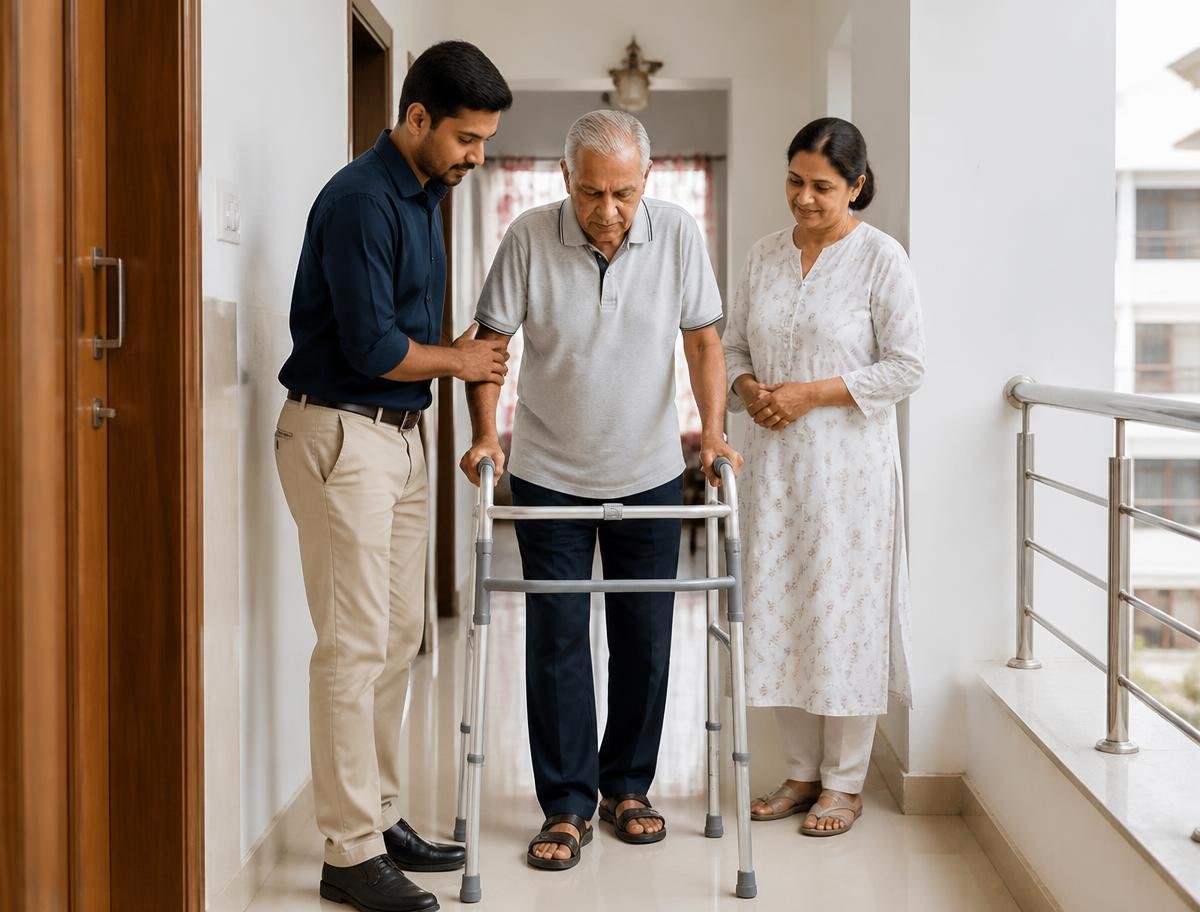
Home physiotherapy service
Mobility and Balance Home Physiotherapy in Indirapuram
Balance is easy to take for granted until it goes. People describe it in odd ways: the floor feeling further away than it should, a wobble when turning quickly, a moment in the shower where they had to grab something. Usually there's no single dramatic event, just a growing sense of not trusting their own feet.
Balance depends on three systems working together, your inner ear, your vision, and the sensation coming from your feet and joints. Something has usually gone wrong in one of them, and the strength to catch yourself has faded at the same time. Both parts are trainable.
Who can benefit
This service suits people who are:
- Unsteady when walking, particularly on turning or on uneven ground
- Recovering mobility after a long illness or hospital admission
- Anxious about falling and therefore moving less
- Using furniture as support to move around the house
- Dizzy or lightheaded when standing up quickly
- Walking with an aid but not confident with it
Common problems and symptoms
How it usually presents:
- Swaying or grabbing for support when standing still
- Difficulty walking in the dark or on patterned flooring
- Needing to stop and steady yourself when turning around
- Shortened steps and a slower walking speed
- Reluctance to step off a kerb or use stairs without a railing
- Fear of falling that limits going out at all
- A stumble on thresholds or doormats
How physiotherapy can help
Assessment tries to identify which part of the system is letting you down. Does the unsteadiness change with your eyes closed, which points to sensation or the inner ear? Does it happen mostly on turning? Is your blood pressure dropping when you stand? That last one is common, easily missed, and worth checking with your doctor.
Training then works on the deficit directly. Balance improves specifically, not generally, so if turning is the problem then turning is what gets practised. Alongside that we build the strength needed to correct a stumble, because a good balance reaction is useless without the leg strength to execute it.
- Balance testing with and without visual input, on different surfaces
- Progressive balance training from supported standing to walking tasks
- Ankle, hip and calf strengthening for stumble recovery
- Turning, stepping and dual-task practice, like walking while carrying something
- Gait retraining, with or without an aid
- Confidence building, since fear of falling limits people as much as the physical deficit
Physiotherapy outcomes differ from person to person and depend on the condition, its cause and other medical factors. This site is general information, not a diagnosis or a treatment plan for any individual. Where a medical review, imaging or a specialist opinion is needed, we will say so and ask you to see your doctor.
The visit
What to expect during a home session
- Initial discussion. When the unsteadiness happens, whether there's dizziness, any falls, medication list and vision or hearing changes.
- Screening. Blood pressure lying and standing where relevant, plus questions that help separate an inner ear cause from a sensory or strength problem.
- Balance testing. Standing balance in several positions, timed, with and without eyes open, held safely within reach of support.
- Walking assessment. Speed, step length, turning and how you manage a threshold or a step, watched over a real distance.
- Treatment plan. Which system looks to be the main problem, what to train first, and what improvement usually looks like over a month.
- Therapy and exercise. Graded balance work at the edge of your ability with the therapist positioned to catch a wobble, plus strengthening.
- Home guidance and review. Daily practice using a kitchen counter for support, hazard fixes, and the same balance tests repeated to show progress.
Home visits
Treatment at home, across Indirapuram and nearby
Why home physiotherapy?
Balance training has to be slightly risky to work. You need to be genuinely challenged, which means it should be done where someone can catch you, and ideally on the surfaces you actually walk on.
Your flat also has its own particular hazards: the step down to the balcony, the marble that's slippery when wet, the corridor light that's too dim at night. Those get identified during the visit and fixed the same week.
- Training on your own flooring, thresholds and stairs
- Supervised practice at a difficulty that would be unsafe alone
- Kitchen counter or sturdy chair used as the support for daily practice
- Hazards identified and dealt with directly
Areas we serve
Balance rehabilitation is often requested alongside stroke and post-surgical care across Indirapuram and Crossing Republik.
Sessions run across Indirapuram, including Ahinsa Khand 1 and 2, Niti Khand, Shakti Khand, Vaibhav Khand, Gyan Khand and Shipra Suncity. We also travel to Vaishali, Vasundhara, Crossing Republik, Noida and Greater Noida West, depending on the day's schedule.
Our address is VPL-19, Lower Ground, Shipra Krishna Vista Plaza, Ahinsa Khand 1, Indirapuram, Ghaziabad 201001, Near Shanti Gopal Hospital and Jaipuria Mall, Indirapuram.
FAQ
Questions about mobility and balance home physiotherapy
Can balance actually be improved, or is it just ageing?
It improves with training, and quite reliably. Balance is a trainable skill supported by strength, and both respond at any age. What it needs is regular practice at a level that genuinely challenges you.
Is dizziness the same as a balance problem?
Not quite. Dizziness that spins is often an inner ear issue and may need specific treatment or medical review. Unsteadiness without spinning is more often about strength, sensation and confidence. The assessment helps separate them.
How long before I feel steadier?
Many people notice a difference in three to four weeks of consistent practice. Bigger gains in walking distance and confidence usually take a couple of months.
Should I use a stick if I feel unsteady?
It can be sensible in the short term, and it should still be part of a plan to reduce reliance on it. Using one that's the wrong height or holding it in the wrong hand can make balance worse.
Is it safe to practise balance exercises alone?
Only the ones set at a safe level, and always within reach of a solid support like a kitchen counter. We'll be explicit about which exercises are for solo practice and which need supervision.
I've become afraid of going out. Can that be addressed?
Yes, and it should be. Fear of falling reduces activity, which reduces strength, which increases real risk. Graded practice outdoors is part of the programme once indoor balance is reliable.
Guides
Related reading for this condition
Fall Prevention at Home: Physiotherapy Tips for Older Adults
Falls are not an inevitable part of ageing. A safer home, appropriate strength and balance work, and review of individual risk factors can help older...
Read the guideWalking Rehabilitation After Surgery
Walking rehabilitation progresses in stages, guided by weight-bearing status and strength.
Read the guideImportance of Balance Training for Senior Citizens
Balance training aims to improve stability and reduce fall risk through progressive, supervised practice.
Read the guideRelated
Other services that may be relevant
Geriatric Home Physiotherapy
Strength, balance and mobility work for older adults, with fall prevention and a focus on staying independent at home.
Stroke Rehabilitation Home Physiotherapy
Home-based rehabilitation after stroke, working on weakness, balance, transfers and getting back to daily tasks.
Post-Surgery Home Physiotherapy
Rehabilitation after joint replacement, fracture fixation, ligament repair and other surgery, delivered from the day you get home.
Book Mobility and Balance Home Physiotherapy in Indirapuram
Call or WhatsApp us to discuss your requirement and availability.
Monday to Saturday: 07:00 - 21:00 · Sunday: 07:00 - 12:00