
Home physiotherapy service
Post-Surgery Home Physiotherapy in Indirapuram
The first two weeks after surgery are where a lot of recovery is quietly won or lost. You're discharged with instructions, a surgical site that hurts, and a family who is nervous about moving you the wrong way. Meanwhile the joint is stiffening and the muscle around it is shrinking faster than most people expect.
Home rehabilitation fits this period well, because getting a post-operative patient into a car and up a clinic's steps is genuinely difficult. We work within whatever your surgeon has specified, including weight-bearing status, range limits and precautions, and we ask to see the discharge summary before starting.
Who can benefit
We regularly work with patients after:
- Total knee replacement or partial knee replacement
- Total hip replacement
- Fracture fixation with plates, screws or nails
- ACL reconstruction and other ligament repair
- Arthroscopic knee or shoulder surgery
- Spine surgery, where the surgeon has cleared rehabilitation to begin
Common problems and symptoms
The problems people face in the early weeks:
- A knee or hip that won't bend or straighten as far as it should
- Swelling that increases every time you do more
- Difficulty standing up from a low bed or Indian-style toilet
- Fear of putting weight through the operated leg
- Walking with a limp that's becoming a habit
- Muscle wasting visible above the knee within two or three weeks
- Uncertainty about which movements are safe
How physiotherapy can help
Early on, the aims are narrow and specific: protect the surgery, control swelling, get range moving before scar tissue sets, and stop the surrounding muscle from switching off. A knee replacement that reaches full extension in the first month behaves very differently from one that doesn't.
Once healing allows, the focus shifts to load. Strength, walking pattern, stairs and then whatever your normal life demands, whether that's a temple visit, a school run or a return to work. Progression is guided by how the joint responds, not by a fixed calendar, though we're clear about which milestones should be arriving roughly when so problems get flagged early.
- Rehabilitation within your surgeon's stated precautions and weight-bearing status
- Swelling control and early range of movement
- Progressive strengthening once the tissue tolerates it
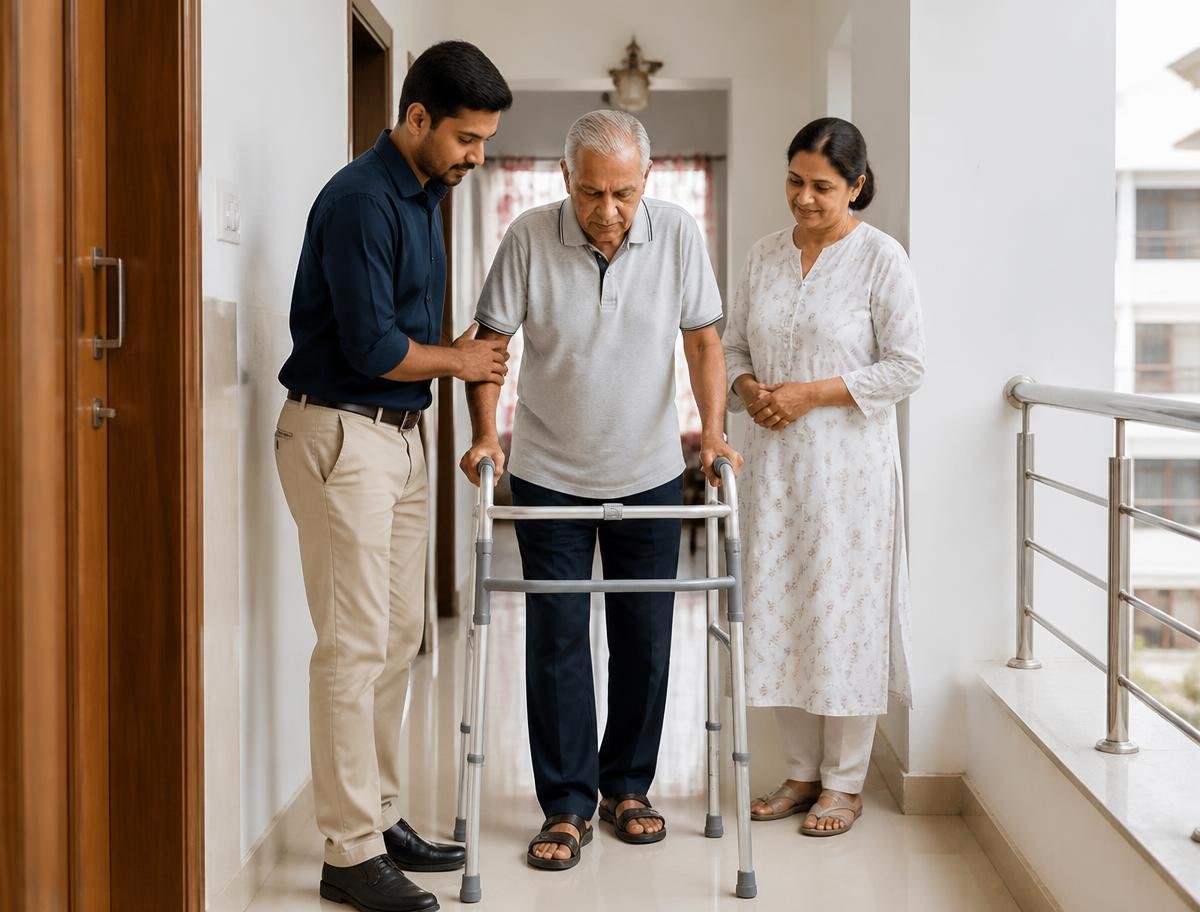
- Gait retraining with a walker, stick or unaided as appropriate
- Safe transfer technique for bed, chair, toilet and car
- Family training so support at home is consistent between visits
Physiotherapy outcomes differ from person to person and depend on the condition, its cause and other medical factors. This site is general information, not a diagnosis or a treatment plan for any individual. Where a medical review, imaging or a specialist opinion is needed, we will say so and ask you to see your doctor.
The visit
What to expect during a home session
- Initial discussion. Date of surgery, procedure performed, surgeon's instructions, medication and how the first days at home have gone.
- Review of the discharge summary. Weight-bearing status, range restrictions and any precautions are confirmed before anything is attempted.
- Wound and swelling check. The surgical site is looked at for signs that need medical attention rather than physiotherapy.
- Range and strength measurement. Joint range measured with a goniometer and recorded, so progress is objective from the first visit.
- Treatment plan. Which milestones matter in the next two weeks, and what should be achieved before the next surgical follow-up.
- Therapy and exercise. Guided range work, muscle activation and, when appropriate, standing and walking practice with the right aid.
- Home guidance and review. A daily routine for the family to supervise, positioning advice for rest, and re-measurement each visit.
Home visits
Treatment at home, across Indirapuram and nearby
Why home physiotherapy?
Practically speaking, most post-operative patients can't travel comfortably for the first few weeks. Stairs, car seats and autos are all difficult with a fresh knee or hip.
There's also a safety angle. The first time a patient walks to their own bathroom or sits on their own toilet seat is much better done with a physiotherapist present than attempted at 2am with a worried relative.
- Rehabilitation starts the day after discharge, without waiting to be mobile enough to travel
- Bathroom, bed and stair transfers practised where they actually happen
- Bed height, chair height and toilet access assessed and adjusted
- Family shown exactly how much to help and when to stop helping
Areas we serve
Many of our post-operative patients are discharged from hospitals along NH-9 and near Indirapuram and continue rehabilitation at home.
Sessions run across Indirapuram, including Ahinsa Khand 1 and 2, Niti Khand, Shakti Khand, Vaibhav Khand, Gyan Khand and Shipra Suncity. We also travel to Vaishali, Vasundhara, Crossing Republik, Noida and Greater Noida West, depending on the day's schedule.
Our address is VPL-19, Lower Ground, Shipra Krishna Vista Plaza, Ahinsa Khand 1, Indirapuram, Ghaziabad 201001, Near Shanti Gopal Hospital and Jaipuria Mall, Indirapuram.
FAQ
Questions about post-surgery home physiotherapy
When should physiotherapy start after surgery?
Usually within a few days of getting home, and sometimes the same week as discharge, unless your surgeon has said otherwise. Early range and muscle activation matter, particularly after knee replacement.
Do you follow the surgeon's protocol?
Yes. We ask for the discharge summary or the surgeon's instructions at the first visit and work within them. If something in the protocol is unclear, we'd rather you check with the surgeon than guess.
How long does rehabilitation take after a knee replacement?
Most people are walking reasonably within six to eight weeks, with strength and confidence continuing to improve for several months. The exact course depends on your pre-surgery condition and other health factors.
Is some pain during exercise normal?
Mild discomfort that settles within an hour or so is expected in post-operative rehabilitation. Sharp pain, increasing swelling, redness, fever or wound discharge is not, and needs your surgeon's attention.
Can you help with walker or stick training?
Yes. Choosing the right aid, setting it to the correct height and using it properly on your own stairs is part of the work.
What if I've already lost movement in the joint?
It's still worth assessing. Range recovered late is harder than range never lost, but improvement is often still possible. We'll be honest about what's realistic given the time since surgery.
Guides
Related reading for this condition
Walking Rehabilitation After Surgery
Walking rehabilitation progresses in stages, guided by weight-bearing status and strength.
Read the guideHow Long Does Post Surgery Physiotherapy Take?
There is no single timeline; duration depends on the procedure, the patient's baseline condition and progress at review.
Read the guidePhysiotherapy After Fracture Recovery
After immobilisation, stiffness and weakness are expected; graded rehabilitation restores movement within medical limits.
Read the guideRelated
Other services that may be relevant
Knee Pain Home Physiotherapy
Rehabilitation for knee arthritis, ligament and cartilage problems, and the stair and squat difficulty that comes with them.
Mobility and Balance Home Physiotherapy
Focused work on walking, steadiness and confidence for people who feel unsafe on their feet.
Home Physiotherapy
A physiotherapist comes to your home in Indirapuram for assessment, treatment and a plan you can actually follow.
Book Post-Surgery Home Physiotherapy in Indirapuram
Call or WhatsApp us to discuss your requirement and availability.
Monday to Saturday: 07:00 - 21:00 · Sunday: 07:00 - 12:00